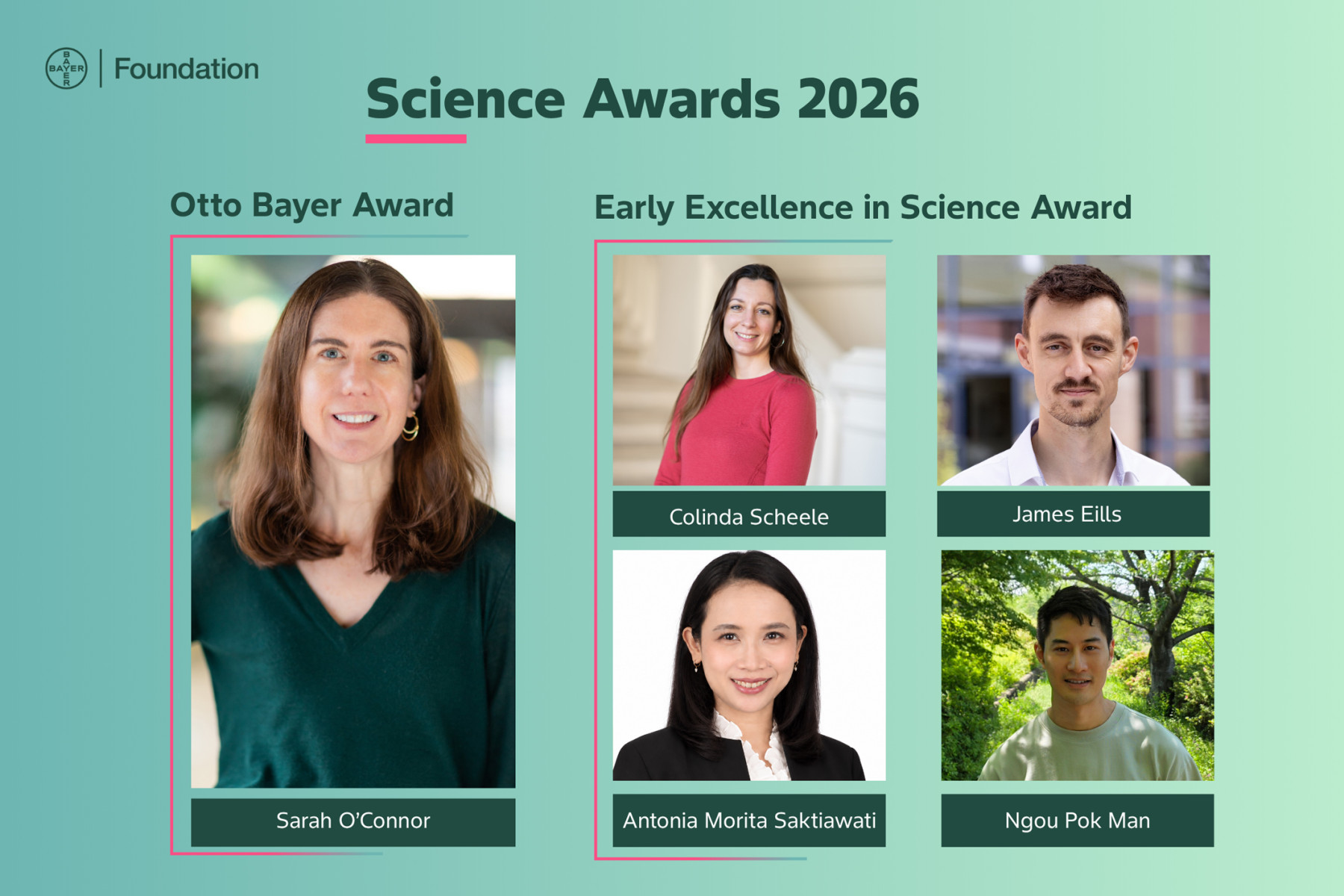
Bayer Foundation honors five outstanding scientists with the Science Awards 2026
Otto Bayer Award goes to plant researcher Sarah O’Connor / Early Excellence in Science Awards recognize outstanding early-career research in biology, chemistry, medical science and plant science / Plant Science award presented for the first time
Leverkusen, October 14, 2026 – In 2026, Bayer Foundation honors five outstanding scientists whose research opens up new perspectives and areas for action in health, agriculture and biomedical innovation. The prestigious Otto Bayer Award goes to Sarah O’Connor. The Early Excellence in Science Awards are presented to Colinda Scheele (Biology), James Eills (Chemistry), Antonia Morita Saktiawati (Medical Science) and Bruno Pok Man Ngou (Plant Science).
Otto Bayer Award 2026: Sarah O’Connor
Bayer Foundation presents the 2026 Otto Bayer Award to Sarah O’Connor, Director at the Max Planck Institute for Chemical Ecology in Jena. She is recognized for her pioneering research into the biosynthesis of natural plant compounds. Her work deciphers how plants produce complex molecules that can be used, among other applications, as medicines against cancer and other diseases.
Through her research, O’Connor has uncovered numerous previously unknown biochemical processes that lead to the formation of valuable natural products, including medically important alkaloids such as vinblastine, quinine and ibogaine. These compounds are used, for example, in the treatment of cancer (vinblastine) or malaria (quinine), or are in clinical trials for treatment of mental health and substance use disorders (ibogaine). Her work lays the foundation for producing important active ingredients more sustainably and efficiently in the future, while opening up new opportunities for drug discovery and development.
The Otto Bayer Award is one of Bayer Foundation’s most prestigious science awards and among the most highly endowed research prizes in Germany. Presented every two years in alternation with the Hansen Family Award, it recognizes leading scientists working in German-speaking countries for groundbreaking research contributions in chemistry or biochemistry. The award, endowed with EUR 75,000, was established in 1984 through a generous provision in the will of Otto Bayer, a former Director of Research at Bayer AG.
With the Early Excellence in Science Awards, the Foundation has recognized emerging talents for remarkable research contributions in the natural sciences since 2009. To date, 51 talents have received the awards. Each Early Excellence in Science Award includes prize money of EUR 10,000 for the researcher.
Early Excellence in Science Award in Biology: Colinda Scheele
The Early Excellence in Science Award in Biology goes to Colinda Scheele from the VIB–KU Leuven in Belgium. She investigates how cancer develops and why some altered cells form tumors while others are stopped by the surrounding tissue.
Her research has shown that even breast tissue that appears healthy from the outside can already contain genetic changes that precede cancer. At the same time, she has identified protective mechanisms in the tissue that prevent tumor formation. These insights open up new possibilities for detecting breast cancer earlier, improving prevention and further advancing therapies.
Early Excellence in Science Award in Chemistry: James Eills
The Early Excellence in Science Award in Chemistry is presented to James Eills from Forschungszentrum Jülich. His research improves methods in magnetic resonance spectroscopy and imaging that are used to visualize biological processes.
Together with his research team, he develops new hyperpolarization methods that significantly increase the sensitivity of these measurement techniques. In the future, this could make it possible to visualize metabolic processes in the body faster, more cost-effectively and without radioactive markers. This opens promising perspectives for cancer diagnostics and other medical applications.
Early Excellence in Science Award in Medical Science: Antonia Morita Saktiawati
In the Medical Science category, Antonia Morita Saktiawati from the Center for Tropical Medicine at Universitas Gadjah Mada in Indonesia is recognized. She develops AI-supported diagnostic tools that can detect infectious diseases such as tuberculosis at an early stage and can be deployed in remote areas, making diagnosis possible even in regions with limited medical infrastructure.
Her research developments include an AI-based system for interpreting chest X-rays (TBScreen.AI) as well as an artificial nose system, also known as an electronic nose or e-Nose, that can detect diseases based on breath samples. Her research helps make life-saving diagnostics faster, more affordable and accessible to significantly more people.
Early Excellence in Science Award in Plant Science: Bruno Pok Man Ngou
The award in Plant Science is new and will be presented for the first time in 2026 to Bruno Pok Man Ngou from the RIKEN Center for Sustainable Resource Science (CSRS) in Japan. His research explores how plants recognize pathogens and defend themselves against them.
Pok Man Ngou has uncovered fundamental mechanisms of the plant immune system and identified new classes of immune receptors. Building on these insights, he is developing new approaches to equip plants with enhanced defense mechanisms. His findings could help to breed crops that are more resistant to disease and to improve harvest yields in the future.
Science with societal impact
With its Science Awards, Bayer Foundation recognizes outstanding research that pushes scientific boundaries while holding the potential to address concrete societal challenges in health, agriculture and the environment. This year’s awardees exemplify a new generation of scientists whose insights are helping advance health, food security and sustainable innovation.
About Bayer Foundation
Bayer Foundation is the corporate foundation of Bayer, dedicated to advancing Science and Social Innovation for a world with Health for All and Hunger for None. Guided by the claim “Innovation that matters,” the Foundation supports transformative innovations in health and agriculture to address systemic challenges, particularly in low- and middle-income countries.
Since 2007, Bayer Foundation’s science programs have reached more than 1,000 early-career scientists with fellowships across 40 countries. Bayer Foundation’s prestigious awards have recognized more than 80 outstanding scientists, of whom five later became Nobel Laureates. In Germany, Bayer Foundation is also driving the support of STEM education and has funded more than 700 STEM school projects with more than EUR 6 million.
For more information, please visit the Bayer Foundation website.
Find more information at www.bayer.com.
Forward-Looking Statements
This release may contain forward-looking statements based on current assumptions and forecasts made by Bayer management. Various known and unknown risks, uncertainties and other factors could lead to material differences between the actual future results, financial situation, development or performance of the company and the estimates given here. These factors include those discussed in Bayer’s public reports which are available on the Bayer website at www.bayer.com. The company assumes no liability whatsoever to update these forward-looking statements or to conform them to future events or developments.
Bayer AG is a holding company with operating subsidiaries worldwide. References to “Bayer” or “the company” herein may refer to one or more subsidiaries as context requires.
Contact
|
Jana op den Winkel ESG – Bayer Foundation |