


The History of Bayer
It all starts with a friendship between two men, plenty of natural curiosity and two kitchen stoves. On these, the merchant Friedrich Bayer and the dyer Johann Friedrich Weskott experimented and discovered how to produce the dye Fuchsine. In 1863, they founded the company "Friedr. Bayer et. comp." in Barmen – a 19th-century start-up with tremendous potential.
Step inside the company’s history:
1863–1881: The Founding Years
On August 1, 1863, the dye salesman Friedrich Bayer and the master dyer Johann Friedrich Weskott founded the general partnership "Friedr. Bayer et comp." in Barmen – today a district of Wuppertal. The purpose of the company was the manufacturing and sale of synthetic dyes.

Founding site of "Friedr. Bayer et comp." at Barmen
The extraction of these dyes from coal tar derivatives had only been invented a few years previously, opening up a new field of business for the still young chemical industry. Their market was the textile industry, which was rapidly growing in the wake of industrialization. The natural dyes used until then were scarce and expensive. New inventions, such as the synthesis of the red dye Alizarin and the high demand for tar dyes, led to a boom in new companies. During this time, numerous dye factories were established, but only innovative companies with their own research and the ability to seize opportunities in the international market managed to survive over the long term. Bayer was one of them.
Establishment of the Stock Corporation
The financial foundation for expansion was laid in 1881 with the transformation of the company into a stock corporation named "Farbenfabriken vorm. Friedr. Bayer & Co." The remarkable growth of the company in its early years was also reflected in the size of the workforce, which grew from three in 1863 to more than 300 in 1881.
Download: Bayer Story: Milestones 1863-1988
1881–1914: Becoming an International Company
From 1881 to 1913, Bayer developed into an internationally active chemical company. Although dyes remained the largest business area, new fields of business emerged. The establishment of a powerful research department by Carl Duisberg was of fundamental importance for the further development of the company. In Elberfeld – which was also the company's headquarters from 1878 to 1912 – a scientific laboratory was created that set standards for industrial research. Bayer's research efforts gave rise to numerous intermediates, dyes, and pharmaceuticals, including the ”drug of the century” Aspirin®, developed by Felix Hoffmann and launched on the market in 1899.

Research Laboratory at Elberfeld around 1890
Establishment of the Pharmaceutical Division
As early as 1888, Bayer had established a pharmaceutical department, which generated an increasingly larger share of total sales. This period also saw the beginnings of the production of organic basic and intermediate products for dyes and pharmaceuticals, as well as inorganic chemicals. In 1904, Bayer began manufacturing photochemicals – developers for films – and in 1906, research into rubber synthesis was initiated.
International Presence
A decisive foundation for the company's development was the establishment of a global sales organization. Already during the founding years, the company supplied dyes to many countries. By 1865, a representative for Bayer had already been active in the USA. A few years later, a stake was acquired in a tar factory in Albany, New York. In the following decades, further foreign investments were made to secure and expand the position in important markets. Just before World War I, the company had subsidiaries in Russia, France, Belgium, Great Britain, and the USA. Of the approximately 10,000 people employed by Bayer in 1913, almost 1,000 worked at foreign locations. More than 80 percent of sales came from exports.
Bayer Cross
The international success of Bayer products was also supported by the introduction of a new company logo in 1904: the Bayer Cross.

Early Bayer logos
Leverkusen Becomes the Company Headquarters
Over the years, the Elberfeld location proved too small for continuous expansion. Therefore, in 1891, Bayer initially acquired the Alizarin Red factory from Dr. Carl Leverkus north of Cologne and later additional land along the Rhine. Following the plans of Duisberg, who led the company as General Director from 1912 to 1925, Bayer systematically developed this location starting in 1895. By 1912, Leverkusen became the company headquarters.
1914–1925: The First World War and Its Consequences
The First World War interrupted the brilliant development. The company was largely cut off from its major export markets, and accordingly, the sales of dyes and medicines declined. Bayer became increasingly integrated into the war economy and began to produce war material, including explosives and chemical weapons. During the war, the third German Bayer plant in Dormagen commenced operations in 1917.
Turbulent times
The effects of the war were devastating. Foreign assets were largely lost, and export markets remained mostly closed. In Russia, the subsidiary was expropriated as a result of the Russian Revolution. In the USA, in 1917, the company's assets, including patents and trademarks, were confiscated and subsequently sold to competitors. By 1919, sales had dropped to two-thirds of the 1913 value. Inflation eroded financial reserves, and in 1923, Bayer did not pay a dividend for the second time since 1885.
Thanks to the constructive cooperation between management and the employees' representatives, Bayer made it relatively smoothly through the uneasy years following the defeat in World War I from the November Revolution until the stabilization of Germany in 1923/24.
The Beginnings of Plant Protection
In the crisis years, the importance of a sufficient supply of food for modern and industrialized societies became evident. This also presented new opportunities for research companies. After an initial preparation for forest protection had been developed in Elberfeld in 1892, Bayer launched a seed dressing agent in 1915. Systematic research and development in the field of plant protection began with the establishment of a plant protection experimental department in Leverkusen at the beginning of the 1920s.

Advertisement for the seed treatment Uspulun, c. 1920
1925–1945: The Era of I.G. Farben
Merger into I.G. Farbenindustrie AG
After the stabilization of the world economy in the mid-1920s, it became clear that the German dye industry could not regain its former position in the world market. To remain competitive and gain new markets, six German companies decided to merge in 1925 into the "Interessengemeinschaft Farbenindustrie Aktiengesellschaft," or simply "I.G. Farben." Like the other companies, Bayer transferred its assets to I.G. Farben and was deleted from the commercial register as an independent company.
The old Bayer works in Elberfeld, Leverkusen, and Dormagen, as well as the plant of ”Chemische Fabriken vorm. Weiler-ter Meer” in Uerdingen, were combined into the so-called Niederrhein operating consortium within I.G. Farben. Leverkusen also became the site of the I.G.’s pharmaceutical sales association – with the Bayer Cross as its trademark.
I.G. Farben and World War II
Since 1936, the policies of the National Socialist government systematically aimed at preparing for war. When World War II finally broke out in 1939, the regime classified the plants of the Niederrhein operating community as vital to the war efforts of the German economy. The economic benefits for I.G. Farben were huge. It recognized the opportunity for a new resurgence and increased production. At the same time, however, a large part of the male workforce was drafted into military service.
Forced labor at the I.G. Lower Rhine operating consortium sites
From 1940 onward, I.G. Farben made increasing use of forced laborers from the occupied countries of Europe in order to maintain and expand production capacities within the Lower Rhine operating consortium. At times, these laborers accounted for up to a third of the workforce.
Around 16,000 people were deployed at the Lower Rhine sites during the war. Thousands of these, predominantly from Poland, Ukraine and further eastern European countries, were forced to work against their will under inhumane and discriminatory conditions. The youngest were 14, while the oldest were just under 50.
Workers from western and northern European countries such as France, Belgium, the Netherlands, Spain and Denmark also made up a large proportion of the workforce.
Memorial Site for Forced Laborers
To embed a company culture guided by remembrance and reflection, Bayer has built a memorial right next to its Headquarters in Leverkusen for the victims of forced labor at I.G. Farben’s Lower Rhine sites during the Second World War.
More information: Link
Dr. Hans Finkelstein –the I.G. and the ousting of Jewish employees
Dr. Hans Finkelstein (1885-1938) was in charge of scientific research at the previously independent company “Chemische Fabriken vorm. Weiler-ter Meer” in Uerdingen which, like “Farbenfabriken vorm. Friedr. Bayer & Co.” with its sites in Leverkusen, Elberfeld and Dormagen, became part of the newly founded I.G. Farbenindustrie AG in 1925. He typifies the fate of people from a Jewish background or who follow the Jewish religion.

Dr. Hans Finkelstein in conversation with colleagues. Laboratory view at the Uerdingen plant, 1932
As a young scientist, Finkelstein had developed the “Finkelstein reaction”, which is recognized to this day. He joined Weiler-ter Meer as a chemist in 1911. In the compulsory questionnaire for academics, he entered “Evangelical Lutheran” under “Religion”. Finkelstein was put in charge of the scientific laboratory and became an authorized signatory with full power of attorney. When the National Socialists came to power and passed the Nuremberg Race Laws, he was defined as a "Jew" and a so-called “non-Aryan”. Finkelstein came from a liberal Jewish family and had converted to Protestantism at the age of ten. Despite this, and having already experienced discrimination, he was forced by the Nazi authorities to leave the company midway through 1938 and to surrender his passport. Embittered and thoroughly disillusioned, he took his own life in Uerdingen’s city park in late December 1938. He and his wife Annemarie had three children. As a “half-Jew”, his son Berthold was later a forced laborer at the same company.
Hans und Berthold Finkelstein Stiftung: Link
The I.G. Farben and the Buna-Monowitz Concentration Camp
During the Second World War, and starting in 1941, I.G. Farben had a chemical factory built in the immediate vicinity of the Auschwitz concentration camp to produce Buna, a synthetic rubber that was an important part of the war economy. In addition to German skilled workers, the company also used thousands of prisoners from the Auschwitz concentration camp to build the factory. They were joined by prisoners of war and forced laborers from all over Europe. To accommodate the workers at what was the largest construction site in the Third Reich at that time, I.G. Farben started building the company’s own Buna-Monowitz concentration camp in 1942, in collaboration with the Nazi regime. Large numbers of laborers died due to the inhumane living and working conditions or were put to death in the nearby Auschwitz-Birkenau gas chambers as soon as they were no longer able to work. The life expectancy of inmates was less than four months, and over 25,000 people lost their lives on the construction site alone.
1945–1951: I.G. Farben trial, early release and reestablishment of Bayer
At the end of the war, the Lower Rhine was among the regions liberated by American troops. The British military government soon assumed complete control over the Lower Rhine sites. When the Allied Forces seized the I.G. in November 1945, it was dissolved, and its assets were made available for war reparations.
The Nuremberg Trials that start in August 1947 include proceedings against senior figures at I.G. Farben. These proceedings break new ground. Together with the parallel trials of Flick and Krupp, they are the first to focus on the ethical and legal responsibility of business leaders for war and crimes against humanity. A total of 23 senior managers from I.G. Farben stand trial during the Nuremberg Military Tribunals. On July 30, 1948, 13 of the accused receive custodial sentences, while the remaining ten are acquitted based on the available evidence. During the trial, no representatives of I.G. Farben show any willingness to acknowledge their own involvement and take responsibility. All of the accused who receive a custodial sentence go on to be granted an early release. Most are soon back in senior roles at their respective companies, including Fritz ter Meer, who is sentenced to seven years in prison for “plunder and spoliation” and for “mass murder and enslavement”.
Fritz ter Meer and the Handling of Responsibility
In 1947, Fritz ter Meer – one of the senior managers of I.G. Farben who are being held by the Allies at Kransberg Castle in the Taunus Mountains before the trial – produces a narrative describing the attitude and actions of the people in charge at I.G. Farben. Referred to as the “Kransberg Memorandum”, it survives to this day. This document makes no mention of the suffering of forced laborers, or the strategic role played by I.G. Farben during the Nazi period. Instead, the memorandum paints a picture of peaceful, patriotic businessmen and scientists who were themselves victims of the National Socialist regime.
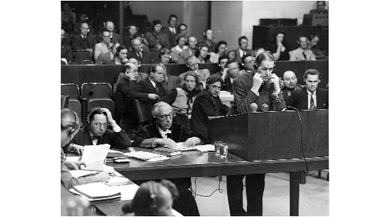
Fritz ter Meer as a defendant in the Nuremberg I.G. Farben Trial
A chemist and entrepreneur, Fritz ter Meer is Chairman of the Supervisory Board of Farbenfabriken Bayer AG and a member of the supervisory board at several other companies in the period between 1956 and 1964.
Re-establishment
After World War II, the works of the Lower Rhine operating consortium were located in the British occupation zone. Very soon, the occupation authority approved the resumption of production, as the products of the chemical industry were essential for the supply of the population.
The Allied military governments initially planned to break up the I.G. into as many small companies as possible, but these would have struggled to survive on the global market or even in Germany itself. The Allies ultimately realized this, too, and 12 competitive new companies were therefore created in the Federal Republic of Germany based on their legislation.
One of these was Farbenfabriken Bayer AG, which was newly founded on December 19, 1951 and allocated the Leverkusen, Dormagen, Elberfeld and Uerdingen sites. Bayer was also assigned a subsidiary – Agfa (Aktiengesellschaft für Fotofabrikation) – which was newly established in 1952.
1951–1974: Reconstruction and "Wirtschaftswunder"
The reconstruction of Bayer is closely linked to the “Wirtschaftswunder” (“German Economic Miracle") in the Federal Republic. As a result of World War II, Bayer lost its foreign assets for the second time, including valuable patent holdings and trademark rights. It was clear that foreign business was of vital importance, and so, already in 1946, under Allied control, the company began rebuilding its foreign distribution. From the 1950s onwards, Bayer was able to acquire stakes again in those markets, initially focusing on the USA and Latin America.
At the same time, the chemical industry underwent a fundamental transformation. Until then, coal had been the basis for many chemical processes, but oil was becoming increasingly important. This transformation towards petrochemicals was expressed at Bayer in 1957 with the founding of Erdölchemie GmbH in collaboration with Deutsche BP. Bayer also entered into strategic partnerships in other areas to strengthen its position. For example, in 1958, Bayer founded the joint venture Mobay with Monsanto for the production of polyurethanes, and in 1964, the two largest photo producers in Europe merged to form Agfa-Gevaert AG.
Research and Development Bear Fruit
In addition to the targeted reconstruction of foreign business and the expansion of strategic partnerships, research was primarily the foundation for the positive business development in the 1950s and 1960s. The expansion of polyurethane chemistry, new plant protection products, fibers such as the polyacrylonitrile fiber Dralon, the thermoplastic Makrolon, new dyes for synthetic fibers, and many other inventions contributed to the company's expansion. New medications such as cardiovascular agents, preparations for combating skin fungal diseases, and broad-spectrum antibiotics shaped Bayer's pharmaceutical research.

Leverkusen Site in 1963
By 1963, Bayer had nearly 80,000 employees again, and sales reached around 4.7 billion DM. The further rapid growth and the increasing variety of products made a reorganization of the group necessary, which came into effect in 1971. A divisional organizational structure replaced the functional organization established in the early 1950s. The elimination of the name component "Farbenfabriken" from 1972 was a reflection of the diversification of the company into a broad range of chemical products.
1974–1988: Oil Crisis and Consolidation
The oil crisis of 1973/74 definitively ended the era of the "Wirtschaftswunder." Within a few months, the prices of chemical raw materials from oil multiplied. Bayer was also affected by this development. The crisis reached a low point in the early 1980s when a severe global recession occurred.
Expansion of Foreign Business
Despite the unfavorable conditions, Bayer pursued its previous strategy and continued to expand its international engagement, focusing on Western Europe and the USA. In 1974, Bayer acquired Cutter Laboratories Inc. in the USA and in 1978, Miles Laboratories Inc. This allowed Bayer to gain a significant position in the US pharmaceutical market.
Expansion of Pharmaceutical and Plant Protection Research
Research efforts were further intensified. Pharmaceutical and plant protection research were continuously expanded. In 1979, construction began on the large plant protection center in Monheim, which required investments of about 800 million DM and could be completed in 1988. In the same year, the pharmaceutical research center in West Haven, Connecticut, was inaugurated. Successful products from Bayer's research during these years included the cardiovascular agent Adalat™ (1975), the medication Ciprobay™ (1986) as Bayer's first broad-spectrum antibiotic from the class of quinolones, and the plant protection product Bayleton™ (1976) against harmful fungi in agriculture. Sales showed a clear structural shift, with the pharmaceutical, plant protection, and plastics and coating raw materials divisions expanding significantly in the 1970s.
Environmental Protection at Bayer
In the 1970s, public awareness of environmental issues increased. Bayer also intensified its efforts in environmental protection. In 1971, Bayer commissioned the largest industrial sewage treatment plant in Europe in Dormagen. In 1980, the Bayer tower biology for biological wastewater treatment was completed in Leverkusen.
The efforts in environmental protection were also reflected in the drastic reduction of emissions. Between 1977 and 1987, the proportion of heavy metals in water decreased by 85 to 99 percent, and pollutant emissions into the air were reduced by 80 percent. The commitment to environmental protection was also reflected in investments. In 1987, the management decided to spend around three billion DM on environmental protection over the next three to five years.
In 1988, the company celebrated its 125th anniversary. The corporate revenue in that year was around 40 billion DM, and more than 165,000 people were employed by Bayer worldwide. In the same year, Bayer AG became the first German company to be listed on the Tokyo Stock Exchange.
1988–2001: Transformation and Globalization
The 1990s were again characterized by profound structural changes. The globalization of the economy posed a challenge for Bayer as well.
In the wake of the political upheavals in Germany and Eastern Europe after 1989, the company increasingly focused on these promising markets. In 1992, the foundation stone for a new Bayer plant was laid in Bitterfeld, which began producing Aspirin™ in 1994.

Bayer Bitterfeld, 1995
The significance of North America for the corporation continued to grow. In Canada, Bayer acquired Polysar Rubber Corporation based in Toronto in 1990. This acquisition made Bayer the world's largest raw material producer in the rubber sector. With a further indication (thrombosis prophylaxis), the World Health Organization (WHO) again included the Aspirin™ active ingredient acetylsalicylic acid in the "List of Essential Medicines." The Aspirin™ active ingredient had already been listed as an "essential medicine" since 1977.
Repurchase of the Company Name in the USA
In 1994, Bayer acquired the North American self-medication business of Sterling Winthrop. This was a milestone in the company's history, as this acquisition also returned the rights to the company name "Bayer" in the USA back to Bayer AG. After 75 years, the company could once again appear under its company name and the Bayer Cross in the USA. In 1995, the American Miles Inc. was renamed Bayer Corporation.
To be better prepared for future challenges, Bayer established a third research center in Japan in addition to its pharmaceutical research centers in Europe (Wuppertal) and North America (West Haven/USA): The research center of Bayer Yakuhin Ltd., the Japanese pharmaceutical subsidiary of the corporation, was inaugurated in 1995 in Kansai Science City near Kyoto. The "Pharma Research Triad" of Europe-North America-Japan was thus fundamentally complete. It was supplemented in the following years by numerous collaborations with innovative companies in the field of biotechnology.
In 2000, Bayer acquired the polyol business of the US company Lyondell Chemical Company, making it the world's largest manufacturer of polyurethane raw materials. In 2001, Bayer acquired Aventis CropScience for 7.25 billion euros, thus catching up with the global leaders in plant protection. On December 6, the management decided to establish independent business units that would remain structurally connected under the umbrella of a strategic holding company.
2001-2019: The Strategic Shift of Bayer AG
From a Chemical Company to a Global Trio of the Divisions Crop Sciences, Pharmaceuticals, and Consumer Health
In recent decades, Bayer AG has undergone a remarkable realignment, transforming from a traditional chemical company into a leading global enterprise with three core divisions: Crop Science, Pharmaceuticals, and Consumer Health. The acquisition of Aventis CropScience in 2001 was the first step towards this strategic realignment.
The years 2003 to 2005 were characterized by a series of restructuring efforts and targeted acquisitions that helped Bayer strengthen and expand its market position. The acquisition of Roche's Consumer Health business in 2005 positioned Bayer as one of the world's leading providers of over-the-counter medications and underscored the company's commitment to grow in the healthcare sector.
Another crucial step was the integration of Schering AG in 2006, which significantly strengthened Bayer's pharmaceutical division. This acquisition enabled Bayer to expand its presence in the pharmaceutical market and develop innovative medical solutions. The strategic focus on the healthcare sector was further reinforced by the acquisition of Algeta in 2014, enhancing Bayer's oncology business.
In addition to acquisitions and internal restructuring, the spin-off of business areas played a significant role in Bayer's strategic realignment. In 2005, Lanxess AG was separated from the Bayer Group. Another significant step was the spin-off of Bayer MaterialScience, which has been operating under the name Covestro since 2015. Covestro was initially managed as an economically and legally independent subsidiary of Bayer AG and made its market debut in October 2015. In 2019, Bayer continued its realignment by announcing the sale of its Animal Health business to Elanco Animal Health and the sale of its shares in the chemical park operator Currenta to MIRA funds.
These spin-offs helped Bayer focus on strategic growth areas and strengthen innovation in the divisions of Crop Science, Pharmaceuticals, and Consumer Health.
In the field of agricultural sciences, Bayer achieved a significant milestone with the acquisition of Monsanto in 2018. This acquisition made Bayer one of the leading providers in agricultural sciences and enabled the company to develop innovative solutions for the challenges of global agriculture. The integration of Monsanto into Bayer Crop Science strengthened the company's position as a global leader in agriculture.

Bayer signage in St Louis
A New Chapter
On June 1, 2023, Bill Anderson took office as the new CEO of Bayer AG. His primary task is to contain the legal risks arising from the acquisition of Monsanto. At the same time, Bayer launched the introduction of the new organizational model "Dynamic Shared Ownership" (DSO). The goal is to accelerate innovations while consistently placing farmers, patients, and consumers at the center of all activities. Bayer is no longer relying on traditional hierarchies but on the expertise of its employees, who can make independent decisions. DSO aims to foster sustainable growth and added value for our customers, employees, and stakeholders and help focus on Bayer's mission: "Health for all, Hunger for none."
